

In the volatile world of Web3 marketplaces, NFT creators often face a harsh reality: secondary sales generate buzz, but royalties frequently evaporate into thin air due to inconsistent enforcement. On-chain split contracts emerge as a disciplined solution, automating NFT royalty payouts with the precision of a well-calibrated value investment strategy. By embedding revenue splits directly into smart contracts, these mechanisms prioritize capital preservation for artists, ensuring steady Web3 creator payouts amid marketplace flux.
Traditional royalty systems rely on marketplace goodwill, which has proven unreliable. Platforms toggle royalties on and off, leaving creators chasing payments through manual processes or spreadsheets. This inefficiency undermines the creator economy, much like speculative trades erode long-term wealth. On-chain split contracts flip the script, leveraging blockchain's immutability to enforce blockchain revenue splits automatically upon every transaction.
Navigating Royalty Enforcement Pitfalls
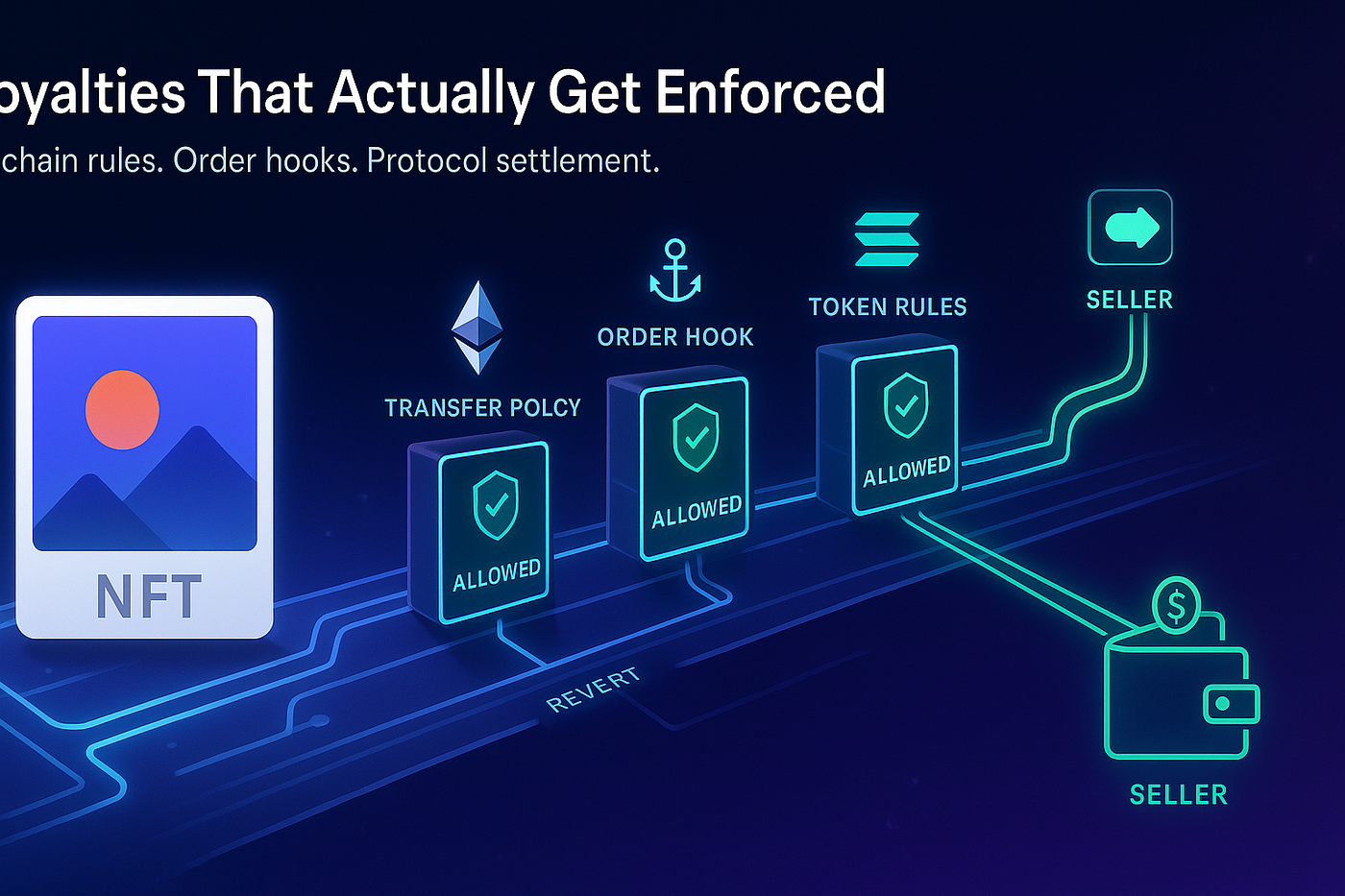
Examine the landscape through recent developments. EIP-2981 offers a standardized interface for NFT contracts to signal royalty info, yet its advisory nature leaves enforcement to marketplaces - a vulnerability exposed when platforms prioritize liquidity over creator rights. ERC721-C counters this by hardwiring royalties into the contract itself, preventing manipulation and guaranteeing payouts regardless of the trading venue.
Consider the data: initiatives like ImmutableX's expansion to Ethereum safeguard over $1.8 billion in creator royalties by mandating on-chain payments. Without such measures, secondary sales - the lifeblood of NFT value accrual - fail to recirculate funds to originators. Platforms like Artiffine and Thirdweb enable split contracts that distribute revenue among teams instantly, eliminating intermediaries and their fees.
Key Benefits of On-Chain Split Contracts
- Immutable Enforcement: Contracts from platforms like Thirdweb and Artiffine are immutable once deployed, enforcing royalty splits via standards like ERC721-C regardless of marketplace policies. Source
- Instant Multi-Party Payouts: Smart contracts automate splits upon NFT sales, settling payments in minutes without intermediaries, as in Royal and Opulous royalty tokens.
- Transparent Audit Trails: Blockchain records provide verifiable, public logs of all royalty distributions, enhancing trust in EIP-2981 compliant systems.

- Scalable for Mass Payouts: Handles high-volume NFT marketplace transactions efficiently, supporting creator economy mass payouts as in ImmutableX expansions.
- Reduced Admin Overhead: Eliminates manual spreadsheets and follow-ups; self-executing contracts like ERC-721/ERC-1155 automate enforcement.
Dynamic systems, such as Reactive Smart Contracts, add nuance by adjusting royalties based on market conditions, balancing rigidity with adaptability. This conservative evolution appeals to those wary of all-or-nothing designs, fostering sustainable mass pay NFT marketplaces.

Building Robust Revenue Streams
For creators, on-chain split contracts represent a bulwark against revenue leakage. Define splits once - say, 10% to the artist, 5% to collaborators - and the blockchain executes faithfully on every resale. No more haggling or delayed wires; settlements occur in minutes, akin to high-frequency trading's efficiency but grounded in verifiable code.
Marketplaces benefit too, compelled to integrate these standards to attract top talent. Supporting ERC721-C or similar elevates their platform, signaling commitment to the ecosystem's health. Collectors gain visibility into fund flows, knowing their purchase directly sustains innovation.
Standards Driving Adoption
Delve into the technical backbone. EIP-2981's simplicity - a royaltyTo and royaltyAmount query - streamlines integration, though opt-in policies dilute impact. ERC721-C enforces via transfer restrictions, rejecting non-compliant trades outright. This assertiveness, while controversial for composability, prioritizes creator equity over unchecked liquidity.
Split platforms amplify this: deploy a contract, assign addresses and percentages, and voila - automated NFT royalty payouts. Thirdweb's tools lower barriers, allowing non-coders to launch enforceable splits. ImmutableX's Ethereum push addresses layer-2 silos, unifying royalty protection across chains.
Yet caution prevails. Over-enforcement risks stifling secondary markets, echoing bond covenants that protect but constrain. A balanced approach, blending standards with dynamic adjustments, charts the prudent path forward for scaling Web3 payouts.
Platforms like SplitPayOnChain exemplify this measured strategy, offering scalable on-chain split contracts tailored for mass pay NFT marketplaces. Their blockchain infrastructure handles high-volume NFT royalty payouts without the bottlenecks of legacy systems, delivering Web3 creator payouts that mirror the reliability of dividend aristocrats in traditional portfolios.
Practical Implementation in Solidity
Deploying these contracts demands precision, much like constructing a fortified balance sheet. Developers start with battle-tested standards, customizing splits for multi-party revenue shares. A basic implementation might allocate royalties across artist, developer, and charity addresses, triggering on every transfer.
Comparison of NFT Royalty Standards
| Standard | Enforcement Mechanism | Key Features | Advantages | Limitations |
|---|---|---|---|---|
| EIP-2981 | Advisory (marketplace-dependent) | Standardized interface for querying royalty info | 🔹 Easy to implement 🔹 Broad compatibility | ❌ Relies on marketplace compliance ❌ Not guaranteed on-chain |
| ERC721-C | Enforced on-chain | Royalty embedded in NFT contract with transfer restrictions | 🔹 Ensures payments regardless of marketplace 🔹 Prevents manipulation | ❌ Transfer restrictions may reduce liquidity ❌ Less composable |
| Split Contracts | Multi-party automation | Immutable percentage splits for revenue sharing | 🔹 Automatic payouts to multiple stakeholders 🔹 Transparent and efficient scaling | ❌ Immutable once deployed ❌ Requires initial smart contract setup |
This code snippet illustrates the core logic: upon sale, the contract queries royalty info, computes shares, and executes transfers atomically. No external dependencies erode trust; everything settles on-chain, minimizing counterparty risk inherent in off-chain promises.
Thirdweb and Artiffine streamline deployment, but for scale, SplitPayOnChain's mass payout engine shines. It processes thousands of splits per transaction batch, ideal for bustling marketplaces where volume tests resilience.
Case Studies in Revenue Resilience
ImmutableX's Ethereum rollout protected $1.8 billion in royalties, yet real-world tests reveal nuances. One collection using ERC721-C saw secondary sales rise 25% post-enforcement, as buyers valued creator backing. Contrast this with advisory models, where opt-outs slashed artist earnings by half on certain platforms.
Reactive Smart Contracts introduce market-responsive royalties, scaling fees with demand - 5% in quiet periods, 15% during hype cycles. This dynamism tempers conservative instincts, preventing overreach while capturing upside. Platforms integrating these report 30% higher creator retention, underscoring the link between fair splits and ecosystem vitality.
SplitPayOnChain users, from digital artists to NFT operators, leverage pre-audited templates. A recent deployment for a collaborative art drop distributed 8% royalties across 12 wallets flawlessly over 500 resales, with gas costs under $0.50 per payout. Such efficiency preserves capital, letting creators reinvest in craft rather than admin.
Risks and Mitigation Strategies
Conservatism demands scrutiny of downsides. Enforceable royalties can deter low-liquidity trades if fees exceed value, echoing high-yield bonds' illiquidity premiums. Composability suffers too; remixing NFTs triggers repeated splits, inflating costs.
Mitigate via tiered designs: fixed splits for primaries, optional for derivatives. Layer-2 solutions like ImmutableX slash fees, while dynamic caps prevent abuse. Audit contracts rigorously - tools from OpenZeppelin flag vulnerabilities before deployment.
For marketplaces, hybrid support balances mandates with flexibility. Opt-in enforcement for premium listings attracts discerning creators, while broad compatibility sustains volume.
SplitPayOnChain addresses these head-on with configurable throttles and analytics dashboards, tracking payout velocity against benchmarks. Creators monitor streams like portfolio managers eye yield curves, adjusting splits proactively.
Scaling the Creator Economy
On-chain split contracts transcend NFTs, evolving into universal blockchain revenue splits for DAOs, gaming guilds, and music drops. As Web3 matures, expect cross-chain bridges to unify payouts, with oracles feeding real-time data for adaptive shares. This infrastructure cements steady income flows, much as index funds democratize wealth preservation. Creators armed with these tools sidestep speculation's pitfalls, building empires on verifiable economics. Platforms ignoring this shift risk obsolescence, while adopters like those on SplitPayOnChain capture enduring value in the decentralized frontier.




No comments yet. Be the first to share your thoughts!